
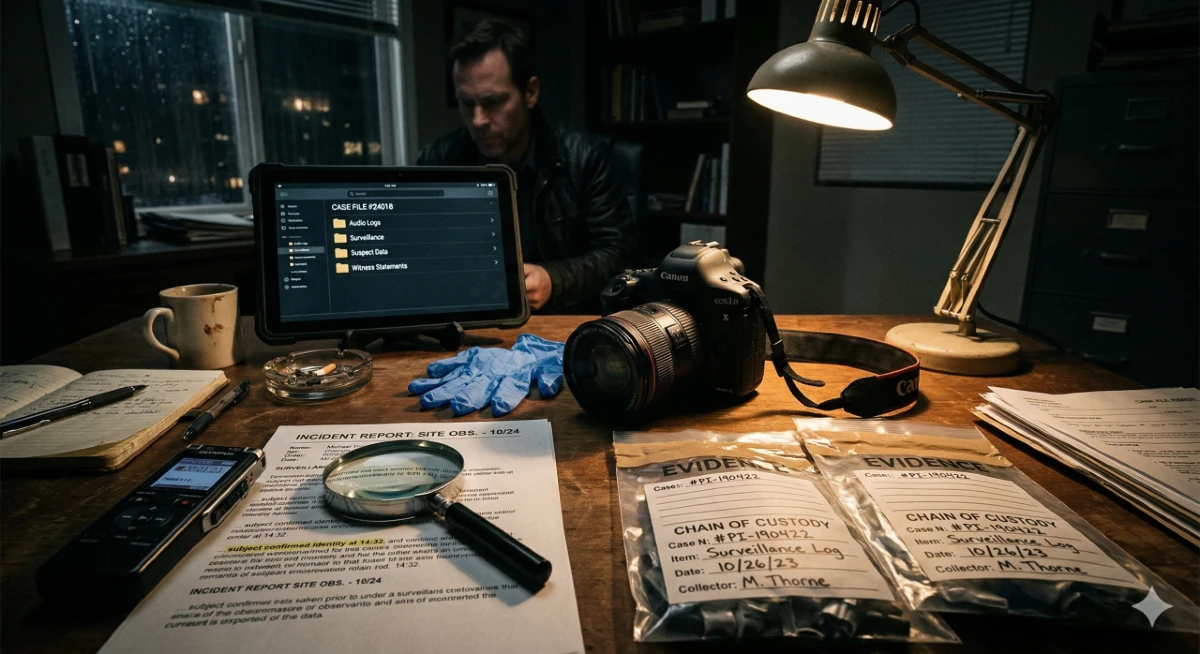
As a private investigator, your value is not just in what you find. It is in what you can prove. You might capture the perfect photo of a subject. You might find a deleted email that solves a case. However, if that evidence cannot stand up in court, it is useless. For professionals in digital forensics and law enforcement, the rules of the game are strict. This guide covers the essential steps to ensure your evidence is always admissible and impactful.
The Gold Standard: Admissibility and the Law
The most important rule for any PI is simple. You are not above the law. Evidence is only useful if a judge allows it. Most evidence is legal if you gather it in public places. If you can see it from the sidewalk, you can usually document it. However, the line between “investigation” and “invasion” is thin.
Understanding Reasonable Expectation of Privacy
The “Reasonable Expectation of Privacy” is a key legal concept. People have this expectation inside their homes or locked cars. They do not have it while walking in a park. If you record a conversation in a crowded mall, it is likely legal. If you plant a bug in a private office, you have crossed a line. Illegal actions can lead to your evidence being tossed out. Even worse, you could face criminal charges yourself.
Avoiding Trespass and Harassment
You cannot break into a home to find a document. You also cannot follow someone so closely that it becomes stalking. Modern PIs must balance persistence with legal boundaries. According to recent industry reports, nearly 15% of PI-led cases face challenges due to “improper collection” methods. Stick to public spaces and open-source data to keep your record clean.
Physical Evidence: Handling the Tangible
Physical evidence includes anything you can touch. This might be a discarded cigarette, a printed letter, or a shell casing. Handling these items requires a “hands-off” approach. Every time you touch an item, you risk changing it. Your DNA or fingerprints could mask the real clues.
The Art of Documentation
Before you pick anything up, take a photo. Use a ruler in the photo to show the size. Note the exact time, date, and weather conditions. These details help prove the item was not tampered with. If you find a footprint in the mud, the temperature matters. It explains why the print was deep or shallow.
Proper Storage Techniques
Once documented, use the right tools to collect the item. Use tweezers or rubber gloves for small objects. Place items in clean, labeled bags or containers. Never put wet items in plastic, as they can grow mold. Use paper bags for items like bloody clothing. Secure storage is the only way to prevent “spoliation,” which is the legal term for ruined evidence.
The Digital Frontier: Forensics and ESI
Today, most evidence is digital. This is known as Electronically Stored Information (ESI). It includes emails, social media posts, and GPS logs. Digital evidence is fragile. One wrong click can change a file’s metadata. Metadata shows when a file was created or edited. If you change it, the defense will claim you forged the data.
Using Write-Blockers and Forensic Images
Never work on the original device. Professionals use “write-blockers” to prevent any data from being written to the drive. They then create a “forensic image.” This is a bit-for-bit copy of the entire drive. You should only perform your analysis on this copy. This keeps the original evidence “pristine” for the court.
The Power of Hash Values
How do you prove a copy is perfect? You use a hash value. A hash value is like a digital fingerprint. It is a long string of letters and numbers created by an algorithm. If even one pixel in a photo changes, the hash value changes. Comparing hash values proves to a judge that your evidence is authentic.
Maintaining the Chain of Custody
The “Chain of Custody” is a paper trail. it shows who had the evidence at every second. If there is a gap in the record, the chain is broken. A broken chain often leads to evidence being excluded. Every handoff must be signed and dated.
Steps for a Strong Chain
- Identify: Give every item a unique ID number.
- Log: Record the name of every person who touches the item.
- Secure: Keep evidence in a locked, limited-access room.
- Transfer: Use secure couriers if you must move items to a lab.
Digital evidence needs a chain of custody, too. Many modern Case Management Systems (CMS) do this automatically. They log every time a user views or downloads a file. This creates an audit log that is hard to dispute.
Recent Trends and Case Facts
The legal landscape is always changing. In 2024, many states updated their data protection laws. These laws impact how PIs can use “scraped” data from social media. Courts are also becoming stricter about “deepfake” evidence. You must be able to prove that a video has not been altered by AI.
In a recent 2024 Texas case, a large settlement was nearly overturned. The issue was a “Letter of Protection” that wasn’t properly disclosed during discovery. This shows that even non-physical evidence, like contracts, must be handled with total transparency. For a PI, being organized is just as important as being sneaky.
Conclusion: Integrity is Your Best Tool
Evidence collection is a science, not just a job. By following these rules, you protect your client and your career. Always prioritize legal standards over quick results. Use technology to your advantage, but never forget the basics of the chain of custody. When you step into that courtroom, your evidence should speak for itself.
List of Evidence Collection Books
The following books can help serve as a great resource to help private eyes learn about the general process. Plus, you can learn the proper procedures and applicable laws for collecting objects and information related to a crime. Private investigators can use these books to learn:
- Proper procedures for collecting forensic evidence and data from the scene of the crime
- How to separate what is helpful from what is not
- How to take crime scene photographs and videos like the pros
- How to correctly store, preserve, and protect evidence from contamination
- How to examine and analyze the objects and information, and draw conclusions about what happened during the crime
- How evidence is presented in a court of law to support conclusions or theories
FBI Handbook of Crime Scene Forensics
| Preview | Product | Price | |
|---|---|---|---|

|
FBI Handbook of Crime Scene Forensics: The Authoritative Guide to Navigating Crime Scenes |
$17.99 |
View on Amazon |
The FBI Handbook of Crime Scene Forensics provides guidance and procedures for safe and efficient methods used by the FBI’s Laboratory and Investigative Technology Divisions.
This book is the official guide for law enforcement agencies, attorneys, and courts that want to submit evidence to the FBI. It covers the right ways to investigate crime scenes, examine evidence, and send it to the FBI safely. The types of evidence discussed include bullet materials, computers, hairs, inks, lubricants, ropes, safe insulations, shoe prints, tire treads, and weapons of mass destruction.
The book also emphasizes the importance of documenting crime scenes using a combination of narratives, photographs, videos, audio recordings, and sketches.
Whether you’re a professional forensics expert or just curious about police investigations and the criminal justice system, the FBI Handbook of Crime Scene Forensics is an intriguing read.
Forensic Investigation Handbook
| Preview | Product | Price | |
|---|---|---|---|

|
Forensic Investigation Handbook: An Introduction To The Collection, Preservation, Analysis, And… | $52.95 | View on Amazon |
The “Forensic Investigation Handbook” is a comprehensive introduction to the critical aspects of evidence collection, preservation, analysis, and presentation within a forensic investigation. Covering a range of disciplines, including criminalistics, digital forensics, and more, the book offers practical guidance for professionals and students alike. Authored by experts in the field, it outlines methodologies to ensure the accurate gathering and handling of evidence while maintaining its integrity. With insights into modern forensic techniques, this handbook provides readers with the foundational knowledge necessary to navigate the complexities of investigative processes and contribute effectively to the legal system.
Other Resources
- The PI’s Guide to Surveillance Gear
- FBI Handbook on Crime Scene Investigation
- NIST Digital Investigation Guidelines
- SWGDE Best Practices for Digital Evidence
References
- https://www.claydugas.com/legal-process/evidence-private-investigators/
- https://www.pinow.com/articles/2618/how-to-handle-evidence-as-a-private-investigator
- https://advantageinvestigators.com/digital-evidence-collection/
- https://vidizmo.ai/blog/why-is-chain-of-custody-important
- https://www.fbi.gov/about-us/lab/forensic-science-communications/fsc/april2000/twgcsi.pdf
- https://www.grantthornton.be/en/the-field/articles-and-publications/Legal/new-legislation-on-private-investigations-key-insights-and-changes/

- Mastering the Art of Process Service: Why Private Investigators Are the Gold Standard - March 1, 2026
- Mastering PimEyes: The Ultimate OSINT Guide for Private Investigators - February 23, 2026
- Navigating Privacy Laws: A Compliance Guide for the Modern Investigator - February 18, 2026