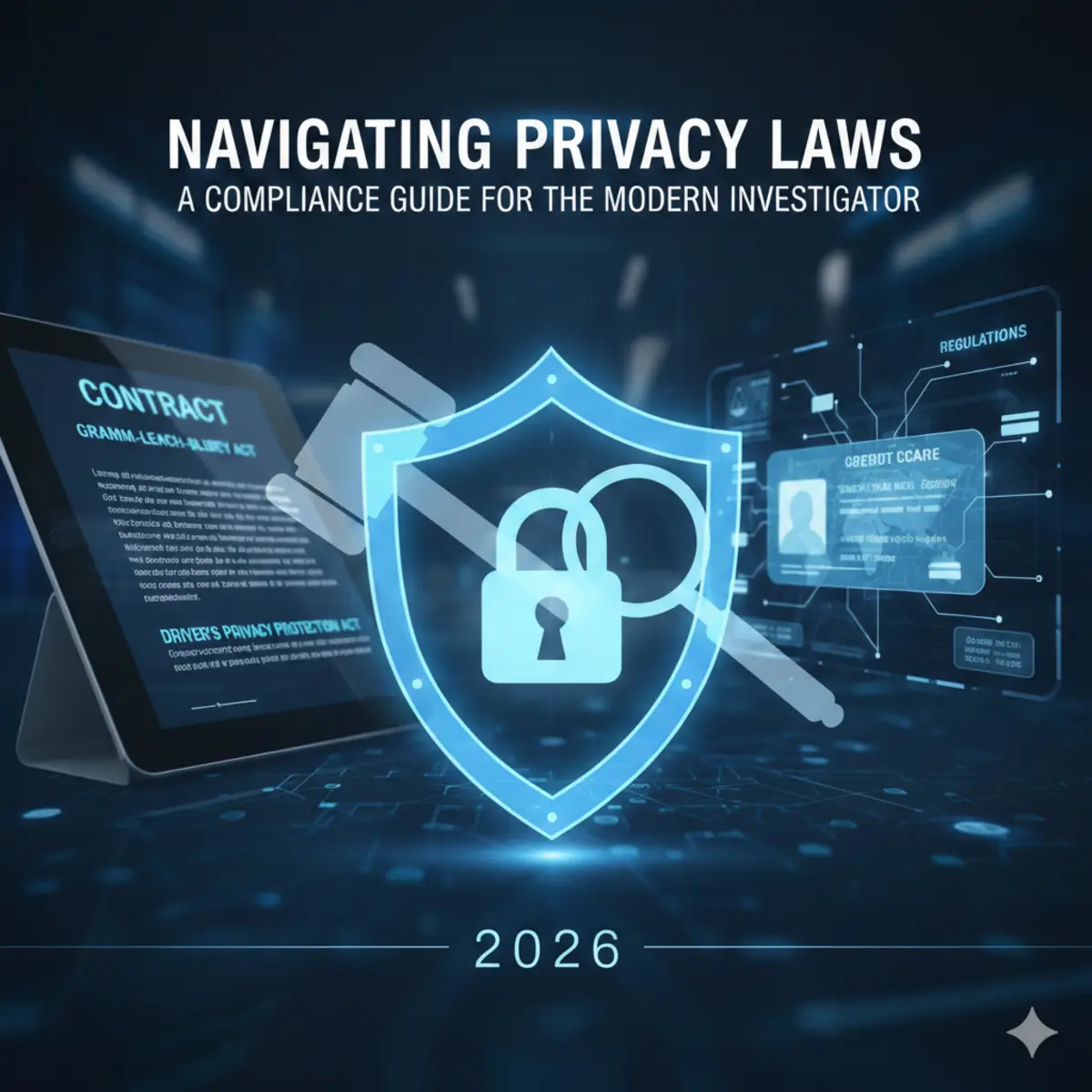
Modern investigations rely heavily on high-quality data. However, the laws governing this data are strict. Two of the most important federal laws are the Gramm-Leach-Bliley Act (GLBA) and the Driver’s Privacy Protection Act (DPPA). These laws dictate how you can access financial and motor vehicle records.
If you ignore these rules, you risk more than just losing a case. You could face heavy fines or even criminal charges. Understanding these laws ensures your evidence remains admissible in court. This guide explains what you need to know to stay compliant in 2026.
Understanding the Gramm-Leach-Bliley Act (GLBA)
The GLBA was passed in 1999 to protect the financial privacy of consumers. It applies to “financial institutions.” This term includes banks, insurance companies, and even some businesses that provide financial advice. The law limits how these groups share “nonpublic personal information” (NPI).
What is Nonpublic Personal Information?
NPI is any data that is not available to the general public. This includes:
- Bank account numbers and balances.
- Credit scores and reports.
- Social Security numbers.
- Information from loan applications.
The Pretexting Rule
For investigators, the Pretexting Rule is a major hurdle. It makes it illegal to obtain customer information from a financial institution under false pretenses. You cannot call a bank pretending to be the account holder to get a balance. This is a federal crime.
Permissible Uses for Investigators
Investigators can still access financial data legally under certain exceptions. Common legal reasons include:
- Fraud Prevention: Investigating insurance fraud or money laundering.
- Legal Compliance: Complying with federal, state, or local laws.
- Judicial Process: Responding to a subpoena or court order.
Recent data shows that federal agencies have increased audits on data brokers. In 2025, several large data providers were fined for failing to verify the “permissible use” of their clients. As an investigator, you must document why you need the data for every search you perform.
The Driver’s Privacy Protection Act (DPPA) Explained
The DPPA is a federal law that protects the privacy of motor vehicle records. It was created after a high-profile stalking case in the 1990s. The law prevents State Departments of Motor Vehicles (DMVs) from sharing personal info without a valid reason.
What Does the DPPA Protect?
The law covers “personal information,” which includes:
- Driver’s license numbers.
- Name and home address.
- Telephone numbers.
- Medical or disability information.
Note that the DPPA does not protect information about accidents, driving violations, or the status of a license. This data is often still public.
Permissible Uses for PIs and Law Enforcement
Licensed private investigators have specific rights under the DPPA. According to 18 U.S.C. § 2721(b)(8), a licensed PI can access DMV records for any “permitted use.” These include:
- Legal Proceedings: Using data for any civil or criminal case. This includes service of process and investigating in anticipation of litigation.
- Insurance Claims: Investigating claims for insurance companies or self-insured entities.
- Fraud Detection: Verifying the accuracy of information to prevent fraud or recover debt.
- Government Functions: Acting on behalf of a government agency.
Penalties for Violations
The DPPA has “teeth.” If you obtain DMV data for an unapproved reason, the victim can sue you. The law allows for:
- Liquidated Damages: A minimum of $2,500 per violation.
- Punitive Damages: If the violation was willful or reckless.
- Attorney Fees: You may have to pay the other side’s legal bills.
Why Compliance Matters for Evidence Admissibility
As a professional, your goal is to provide evidence that holds up in court. Under the Federal Rules of Evidence (Rule 402), relevant evidence is generally admissible. However, evidence obtained in violation of federal statutes can be challenged.
If a defense attorney proves you violated the GLBA or DPPA, they may file a “motion to suppress.” This could lead the judge to throw out your evidence. Even if the evidence is allowed, your credibility will be ruined. A “dirty” investigation can destroy a client’s case and your reputation.
Best Practices for 2026
To stay safe, follow these steps:
- Maintain Licenses: Ensure your PI license is active and registered with your data providers.
- Keep Detailed Logs: Save a copy of the case file that justifies every DPPA or GLBA search for at least five years.
- Audit Your Vendors: Only use reputable data brokers who require you to certify your permissible use for every search.
- Stay Updated on State Laws: States like California and Maryland have passed even stricter privacy laws that might go beyond federal standards.
Privacy laws are not meant to stop your work. They are meant to ensure that personal data is handled with respect and integrity. By mastering the GLBA and DPPA, you protect yourself, your clients, and the profession. Always remember that the “short cut” of pretexting or unauthorized access is never worth the long-term risk.
Relevant Links for More Information
- Federal Trade Commission: GLBA Compliance Guide
- U.S. Code: 18 U.S.C. § 2721 (DPPA)
- Consumer Financial Protection Bureau (CFPB) Privacy Rules
Sources
- https://www.ftc.gov/business-guidance/resources/how-comply-privacy-consumer-financial-information-rule-gramm-leach-bliley-act
- https://uscode.house.gov/view.xhtml?req=granuleid:USC-prelim-title18-section2721&num=0&edition=prelim
- https://www.law.cornell.edu/rules/fre/rule_402
- https://www.venable.com/insights/publications/2026/02/whats-driving-the-rise-in-drivers-privacy
- https://www.nelsonmullins.com/insights/alerts/privacy_and_data_security_alert/all/from-privacy-impact-assessments-to-algorithmic-accountability-2026-s-top-privacy-and-ai-compliance-priorities

- BeenVerified Public Records Tool for Private Investigators - May 1, 2026
- Insurance Fraud Investigations - April 1, 2026
- The Magnum P.I. Private Investigator Legacy: Defining a Profession - April 1, 2026